This week in Humanities we were asked to read Hamlet and then perform it in small acting troupes to the rest of the class.
Saturday, September 19, 2009
to be or not to be
as you like it.
In As You Like it, there are two characters who stole my heart. Rosalind and Celia are two very relatable characters that would help any teenage girl understand Shakespeare a little better. However, although I first fell in love with them in the book, my appreciation grew even stronger when I saw the play and viewed their interpretation of their parts.
This production of As You Like it was performed at the Globe Theater on September 14, 2009. The Royal Shakespeare Company in London England performed it. It was a strong adaptation full of comedy and passion. I enjoyed the use of the pillars on stage as trees and later a backdrop for a wedding. The character of Touchstone was enjoyable in this production with his humor wit and all around goofy performance. He was far less annoying than he was in the book. Even Oliver, the dreaded older brother was likeable as he comes in at the end repentant and in love. I felt the brotherly bond between the two brothers Orlando and Oliver much more in this play then when I read it. Even as they were wrestling, you could still sense their bond that came from growing up together. Even through a great deal of hate, that emotion couldn’t seem to be masked.
As I read the play, I appreciated Celia and Rosalind’s bond and their true love for each other. Their sisterly relationship was so devoted and strong that it was difficult to ignore. However, being a Shakespeare play, everything seemed much more serious and mature. Even when in love or traveling in the wilderness, these characters didn’t seem like young teenage girls but more like mature women. In the actual play, when Rosalind first fell for Orlando both girls were so giddy and silly. I appreciated this so much more because I know that is how I am with my friends in those situations.
When Orlando puts up poems in the trees about Rosalind, Rosalind is very curious. This is the same in the book. However, as the actresses played out the scene where Rosalind is asking Celia about the man who has done that, I was much more intrigued as the girls ran through the stage talking about Orlando. The two characters were giggling, laughing and jumping around. I felt that this conversation could be portrayed a number of different ways. For one, Celia could be resentful and mad that Rosalind was interested in Orlando. She could be disappointed in Rosalind or annoyed with Orlando. But here, we see a normal adolescent intrigued about a new situation.
In Howard’s article about cross-dressing he says that often times as women cross dress, even though they are choosing to be seen as a masculine figure, it becomes more obvious that they are women due to the flaws in their portrayal. That idea wasn’t an obvious one as I read the play, however, as it was being acted on stage, it was clear that Rosalind could never mask her femininity. She was continuously giddy about Orlando, even when others were around. And as they kissed during their fake wedding, she was much more interested in it than a boy would have been. Like Howard says, it is impossible to mask ones true gender even through costumes and slight personality alterations.
As You Like It was a comedic and romantic performance. Once again, Shakespeare’s work jumped off the page and onto the stage to create a masterpiece. Although the plays can each be interpreted in many different ways and performed with many alterations, I was pleased with the result of this particular production. I enjoyed the happiness, humor, and romance a great deal and could relate on a much higher scale.
sat sri akal.
pilgrimage to canterbury.

seats of power.
As we headed down the road we encountered many statues of important people in British history. We saw a statue of Charles G Gordon who was deeply involved in British affairs in China and Africa in the 19th century. This statue stands as a memorial to his life and death.
Just adjacent to the statue was a deep well with stone steps. These steps were built for Queen Mary II to have a better view of the Thames.
As we continued on we came to a statue of William Tyndale. William Tyndale played a major part in the British reformation when he began translating the Bible. He smuggled pages of the Bible in a page at a time until he was later forced to flee and then killed for his efforts.
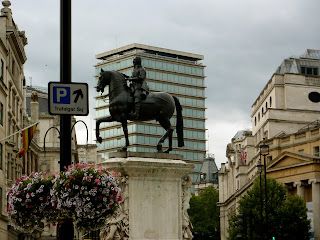
We soon came upon Trafalgar Square and a statue of Charles I. As we got to Trafalgar Square, I realized how connected the city was. The other day when we were at the National Gallery, I didn't notice how close we were to the Thames and Big Ben. But in all reality, everything is just blocks away from each other.
Then we headed to see the Horse Guards. We couldn't get a very good luck however, because they were carrying out a formal inspection of the guards and the courtyard was full of people.
As we continued walking we came upon 10 Downing Street. This was a very interesting park of our walk as this spot is such a famous landmark in London. For one, the Prime Minister lives there. Also, this area is like the White House for England. Being so, the area was heavily guarded and gated.
We carried on to see Big Ben, Parliament, Westminster Abbey, The Mall, Kensington Palace and many statues.
I really enjoyed this walk. For one, it was interesting to see how close everything is. I never realized how truly small the city of London was until I actually made my way through the city. I also thought it was interesting to see all these sights that I have heard about all my life and be able to understand more fully how everything works.
Tuesday, September 8, 2009
the madonna and the virgin.


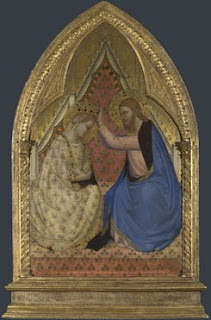
Coronation of the Virgin by Bernardo Daddi
(my selection from the Medieval time period)
In the National Gallery, I chose two different paintings, one of each from the medieval world and the Renaissance. The painting I chose from the medieval world was Coronation of the Virgin by Bernardo Daddi and the painting from the renaissance was The Garvagh Madonna by Raphael. Both these paintings focused on Christ. However, Daddi’s depiction of Christ was shown from an older age where as Raphael showed Christ as a baby. Both paintings also involve one particular woman. Perhaps this woman was the most important woman in His life. In one it was the virgin, in the other it was the Madonna, however you spell it out, it was His mother.
Colors were important and symbolic aspects of both paintings. In the Coronation of the Virgin, Christ is wearing a blue robe, which shows celestial glory. In The Garvagh Madonna, John the Baptist is handing Christ a pink carnation. Pink or red often symbolizes love and affection showing that John truly loved his cousin. Raphael used geometric shapes in his painting where Daddi used lines to show depth. However, Raphael also used many vertical lines in his architecture. Both painters used wood but Raphael worked with oil and Daddi used egg tempura. In Daddi’s piece and many other medieval works, gold leafing is very common. Both pieces of art had some sort of gold piecing above the heads. Daddi’s was more ornate and big while Raphael’s was just a simple halo. Raphael used a much less ornate design over all. Daddi’s painting had ornate shapes and designs covering the whole piece.